Calmer Divorce: a SvelteKit site for planning the next steps
We built Calmer Divorce with SvelteKit: practical guides and a free, personalized divorce checklist that keeps answers in the browser.
The work
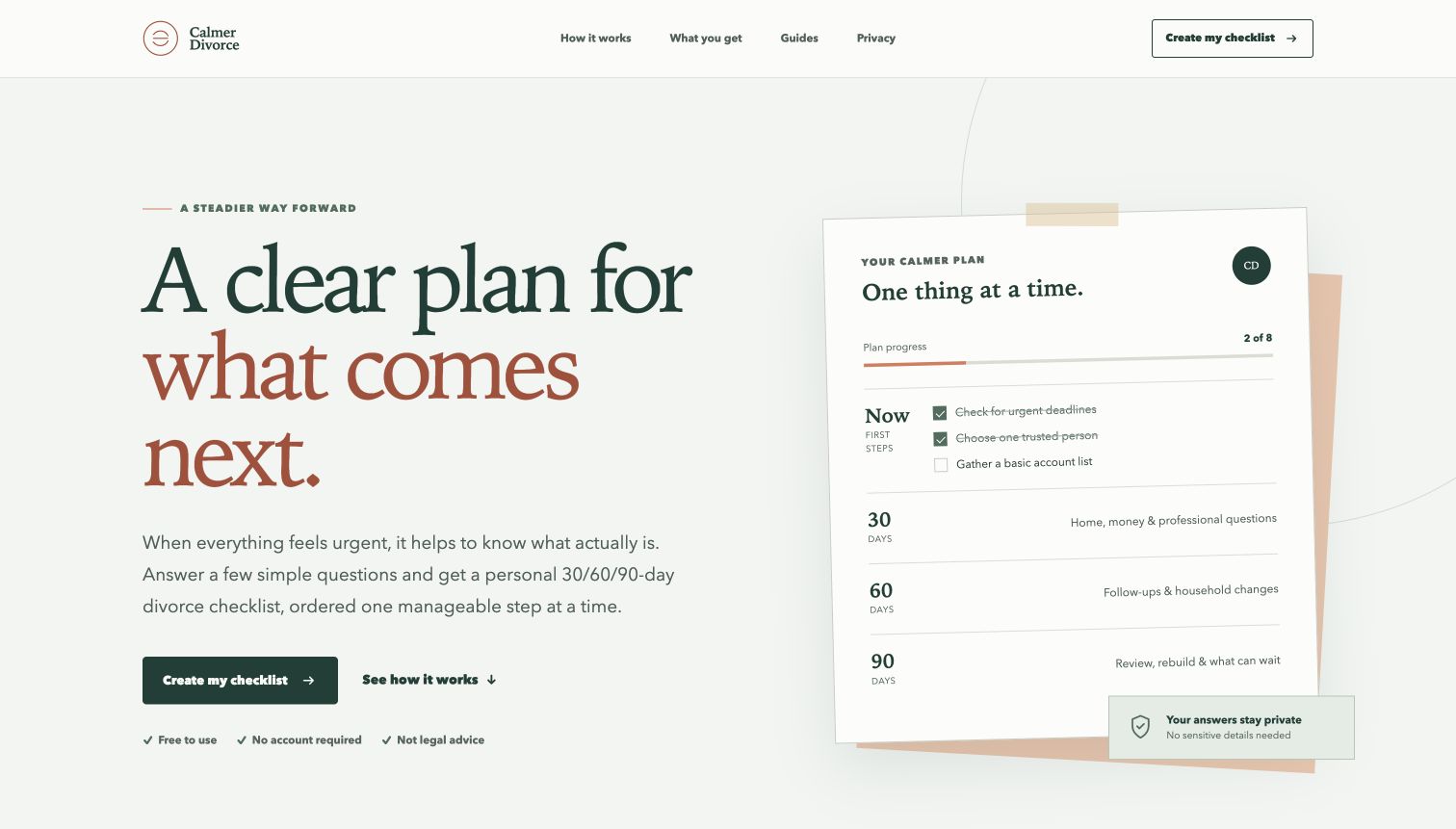
We built Calmer Divorce as one of our own SvelteKit projects. It combines practical guides with a free checklist for people preparing for divorce, going through it, or sorting out life afterward.
A useful place to start
A reader can arrive with a very specific question about money or paperwork, then realize there are several other things to organize. We wanted the site to give them something they could use immediately, alongside the longer articles.
The checklist asks five broad questions: what stage you are at, whether children are involved, whether you share a home or finances, and what you want to focus on. It turns those answers into tasks grouped into now, 30 days, 60 days, and 90 days. Those groups help organize the work; they are not a prediction of how long a divorce will take.
Personalization without an account
The form does not ask for names, account balances, or a description of the relationship. Its answers stay in the open page. There is no account to create, and the checklist does not save those answers for the next visit.
That choice has a practical consequence: readers need a way to take the plan with them. They can check off tasks on the page and use the browser print dialog to print the plan or save a PDF. The interface says what the button does, including the fact that the browser handles the PDF.
Try the personalized divorce checklist to see the questions and the resulting plan.
Articles with tools inside them
The guide pages support checklists and printable worksheets inside the article. A reader can work through a task where it is explained, then print the relevant worksheet. The same content system supports FAQs and a table of contents for longer guides.
The site keeps the scope of that help clear. It organizes practical next steps and questions to take to a qualified professional. It does not present a generated plan as legal advice or claim to know which court deadlines apply to someone.
How we built it
The frontend uses SvelteKit 2 and Svelte 5, deployed to Cloudflare Workers. Statamic holds the guides and pages, and the frontend reads them through a typed GraphQL client. Editors can update structured content in the CMS while the Svelte components handle how each block appears and behaves.
The checklist uses local Svelte state and explicit rules to assemble its tasks. Its behavior is readable in the application code: a different stage changes the relevant follow-ups, and answers about children, housing, or finances add the corresponding tasks. It does not need to send those answers to a generation service.
This is a content site with a small application inside it. The articles explain the subject; the checklist gives the reader a plan they can take away.
Visit Calmer Divorce.
Like this kind of work?
Tell me what you're building. I'll tell you whether a sprint is the right shape, usually within a day.