HaulFacts: a SvelteKit carrier lookup and freight resource
We built HaulFacts with SvelteKit: a public carrier lookup, a selected US trucking directory, practical guides, and free freight calculators.
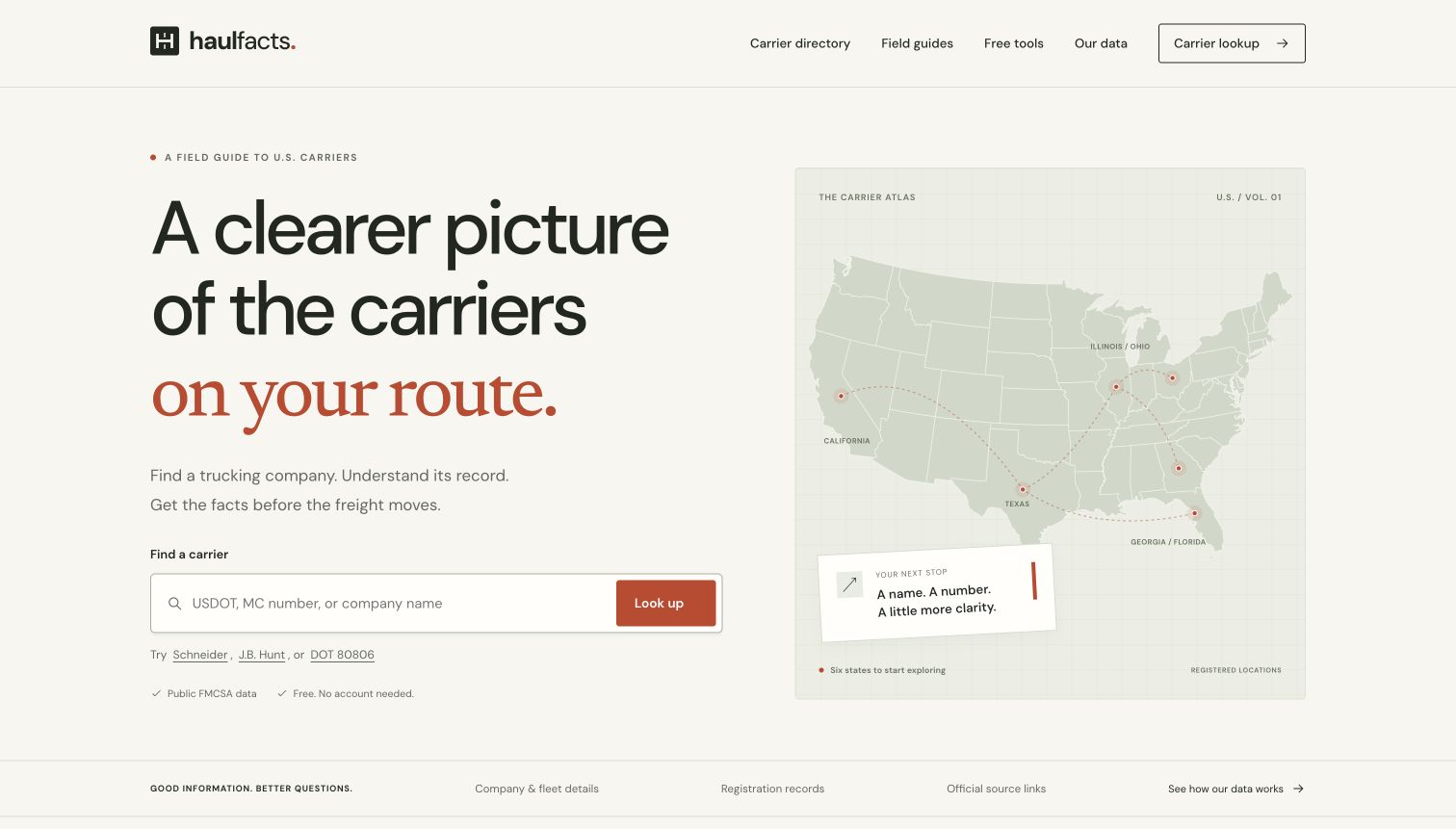
The work
We built HaulFacts as one of our own SvelteKit projects. It brings public US carrier records, a selected trucking directory, and practical freight guides into one site. Readers can use the lookup and calculators without creating an account.
Making a carrier record easier to read
A company name or a number is often the starting point. The lookup accepts a USDOT number, a prefixed MC number, or a company name, then queries public FMCSA Census data. The result links back to official sources so the reader can continue their checks.
The interface needs to explain what a record means as well as display it. A public record is not proof of current insurance, operating authority, or available capacity. HaulFacts shows source information and dates, and keeps official verification links close to the record.
Missing data and an upstream service failure also need different explanations. We built explicit states for those cases, so a failed request does not quietly look like a carrier that does not exist.
The carrier lookup is the quickest way to try it with a company name or USDOT number.
A directory with a defined scope
The directory is a selected snapshot of public records. It does not claim to include every active US carrier. State pages give readers a way to browse that selection, while the lookup handles searches outside it.
The project includes a repeatable refresh script for the directory data. Keeping a record of the snapshot and its source is part of the product: a directory page needs to tell readers what they are looking at and when the data was observed.
Tools for the calculation at hand
Alongside the records, we built calculators for freight density, trucking cost per mile, and fuel surcharges. They run in the browser and show the assumptions behind the result. Example inputs are examples, rather than a claim about current market prices.
The guides cover tasks such as preparing a carrier packet or checking a carrier before pickup. They link to the relevant tools and official references. That gives readers somewhere useful to go after they have found the initial answer.
Browse the freight calculators for the calculation inputs and explanations.
How we built it
HaulFacts runs on SvelteKit 2 and Svelte 5 on Cloudflare Workers. The guides live in Markdown and use mdsvex for their presentation. The application renders useful page content on the server, with separate routes for carrier records, state directories, guides, and tools.
The public-data integration handles input validation and source responses on the server. Tests cover details such as prefixed MC numbers and company names that happen to begin with DOT or MC. The calculators have their own boundary tests, because a plausible-looking answer with the wrong units would be worse than an obvious error.
For discovery, the site includes canonical URLs and sitemaps for its public pages. Arbitrary lookup results stay out of the index. This keeps the searchable directory and editorial content distinct from whatever a visitor types into the search box.
Visit HaulFacts.
Like this kind of work?
Tell me what you're building. I'll tell you whether a sprint is the right shape, usually within a day.